
Aboriginal and Torres Strait Islander Child Placement Principle
The Aboriginal and Torres Strait Islander Child Placement Principle recognises the importance of connections to family, community, culture and country. It guides our legislation, policy, and practice.
As we work with Aboriginal and Torres Strait Islander children, young people, families and communities, we use the Aboriginal and Torres Strait Islander Child Placement Principle to:
- ensure an understanding that culture underpins and is integral to the safety and wellbeing of Aboriginal and Torres Strait Islander children and is embedded in policy and practice
- recognise and protect the rights of Aboriginal and Torres Strait Islander children, family members and communities in child safety matters
- increase the level of self-determination of Aboriginal and Torres Strait Islander people in child safety matters
- reduce the over-representation of Aboriginal and Torres Strait Islander children in child protection and out-of-home care systems
When making a decision about an Aboriginal and Torres Strait Islander child, we carefully consider how these decisions will impact their cultural identity and their connection to family and community in the long term.
The decision must also be made:
- in a way that allows the full participation of the child and the child's family group
- in a place that is appropriate and safe to Aboriginal tradition or Island custom
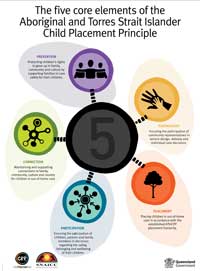
- in a way that upholds the following five core elements of the Aboriginal and Torres Strait Islander Child Placement Principle:
- Prevention - that a child has the right to be brought up within the child's own family and in their community and culture
- Participation - that a child and the child's parents and family members have the right to participate in significant decisions under the Child Protection Act 1999 about their child.
- Partnership - that Aboriginal and Torres Strait islander peoples have the right to participate in significant decisions under the Child Protection Act 1999 about Aboriginal or Torres Strait Islander children, including the design and delivery of programs and services that support Aboriginal and Torres Strait Islander families or provide for the safety and wellbeing of Aboriginal and Torres Strait Islander children.
- Placement - that if a child is to be placed in care, the child has a right to be placed with a member of the child's family group in accordance with the hierarchy of care arrangement options for the child
- Connection - that a child has a right to be supported to develop and maintain a connection with the child's family, community, culture, traditions, language and country.
The Aboriginal and Torres Strait Islander Child Placement Principle also guides our department when making a decision about where an Aboriginal and Torres Strait Islander child or young person should live if they are placed in care. The decision of where and with whom an Aboriginal and Torres Strait Islander child will live is a significant decision and requires Child Safety to consult with child and their parents about having an independent person support their participation in this decision.
When an Aboriginal and Torres Strait Islander child is not able to remain safely at home or if the child is already in care and requires a new care arrangement, the placement element asserts the child’s right to be placed with a member of their family group as the first consideration.
If a child is not able to be placed with their family group the following care arrangement options for the child should be considered in order of priority:
- with an Aboriginal or Torres Strait Islander person who is part of the child's community or language group
- with another Aboriginal or Torres Strait Islander person
- with a person who lives near the child's family, community or language group and who has demonstrated capacity for ensuring the child’s connection to kin, country and culture.
 This work is licensed under a Creative Commons Attribution 4.0 International (CC BY 4.0) licence